
MemoryFuel Ingredients: Every Active, Milligram by Milligram, With the Research
A monograph for each of the five actives printed on the MemoryFuel jar: what it is, how much you get, what human studies show at that dose, and where the label and the advertising disagree.
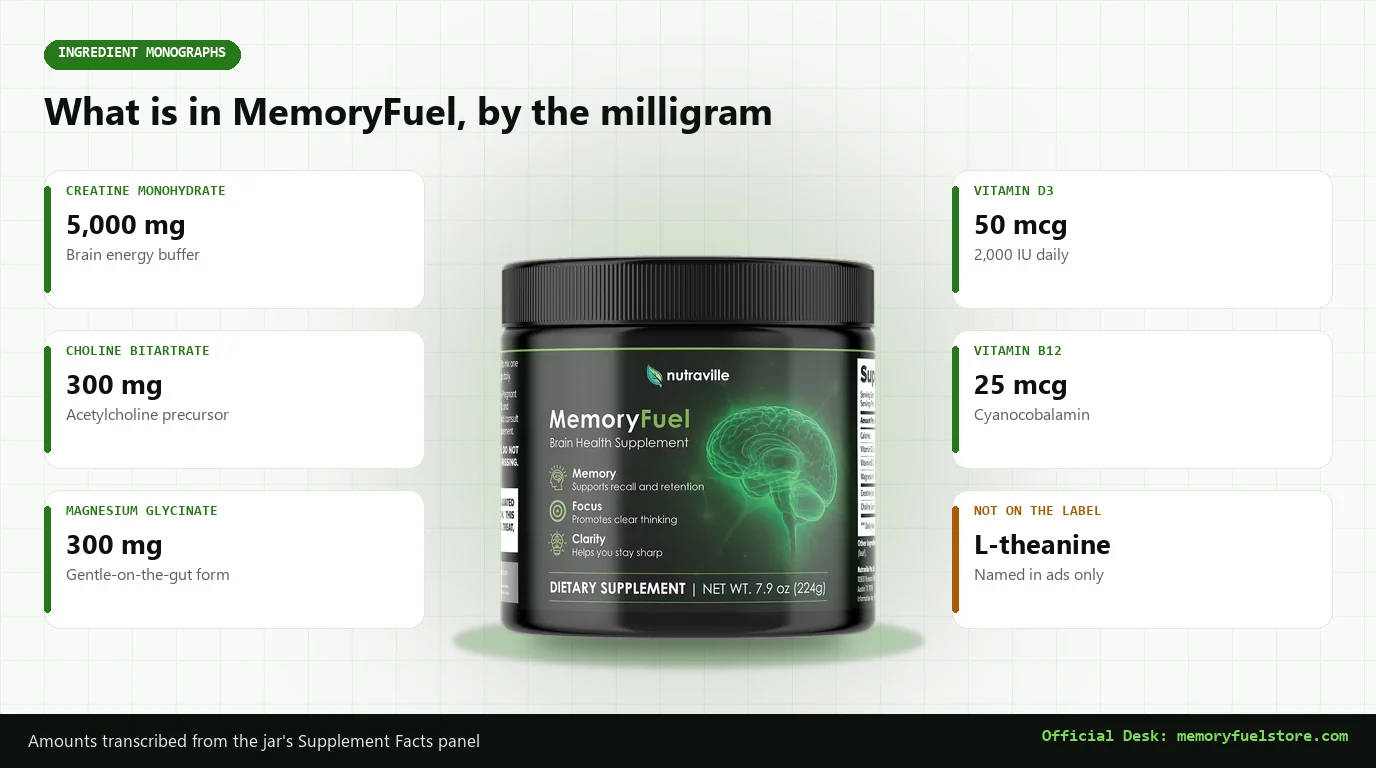
MemoryFuel ingredients: the short version
MemoryFuel contains five active ingredients and three other ingredients, and every active has an amount printed on the Supplement Facts panel. That alone sets it apart from many memory products, which hide their doses inside a proprietary blend. Here is the full list as printed, with the form each nutrient comes in and the job it is supposed to do.
| Ingredient | Per scoop | Form on label | Intended role |
|---|---|---|---|
| Creatine | 5,000 mg | Monohydrate | Phosphocreatine energy buffer |
| Choline | 300 mg | dl-choline bitartrate | Acetylcholine and membrane building block |
| Magnesium | 300 mg (71% DV) | Glycinate | Enzyme cofactor, ATP handling, nerve signaling |
| Vitamin D3 | 50 mcg (250% DV) | Cholecalciferol | Status nutrient often low after 50 |
| Vitamin B12 | 25 mcg (1042% DV) | Cyanocobalamin | Nerve and blood health; absorption falls with age |
The other ingredients are natural flavors, silicon dioxide and stevia leaf extract. There is no caffeine, no herbal blend and, despite what some ads say, no L-theanine on the panel we examined. The sections below go through each active in the order of how much it matters to the formula.
Creatine monohydrate (5,000 mg): the anchor ingredient
Creatine is a small molecule made from three amino acids, mostly in the liver and kidneys. Your body produces roughly a gram a day and a mixed diet adds about another gram, almost entirely from meat and fish. About 95 percent of the body's creatine sits in muscle, but the brain keeps its own supply and can make some on site. Inside cells, creatine is converted to phosphocreatine, which donates a phosphate to ADP to regenerate ATP in a fraction of a second. That makes it a buffer: it does not create energy from nothing, it keeps energy available when demand spikes.
Monohydrate is the form used in nearly all the research, including the brain studies. It is absorbed almost completely and is cheap to produce, which is why other "advanced" creatines have never shown a clear advantage. Five grams a day is the standard maintenance dose in sports nutrition and the dose used in the best-known memory trial[1].
What the research found:
- Young vegetarians, 5 g a day for six weeks: better working memory (backward digit span) and reasoning scores than placebo[1].
- Vegetarians vs. omnivores, 20 g a day for five days: memory improved in vegetarians, with little change in meat eaters[2].
- Systematic review, 2018: six trials; short-term memory and intelligence/reasoning improved in some, with signals strongest in older adults and under stress[3].
- Meta-analysis, 2023: ten randomized trials; a small overall memory benefit and a larger one in adults aged 66 to 76[4].
- Brain imaging: 20 g a day for four weeks raised total brain creatine by roughly 9 percent on average, with regional variation[5].
- Sleep deprivation, 2024: a single dose of about 0.35 g per kilogram (around 25 g) improved processing speed and short-term memory during a night without sleep[6].
Safety at 5 g a day is well documented. The International Society of Sports Nutrition reviewed trials lasting up to several years and found no consistent harm in healthy people[7], and a 2021 review addressed common myths about kidney damage, hair loss and dehydration[8]. The cautions are real but narrow: people with kidney disease, and anyone whose doctor tracks creatinine.
Our take: this is the most evidence-backed ingredient in MemoryFuel and the dose is right. The open question is how much benefit a person who already eats meat and sleeps well will notice. Trials suggest older adults, vegetarians and people under mental or sleep stress are the likeliest to feel a difference.
Choline (300 mg as dl-choline bitartrate)
Choline is an essential nutrient that the liver can make only in small amounts. The body uses it to build cell membranes (as phosphatidylcholine), to move fat out of the liver, and to make acetylcholine, a messenger central to attention and memory. Eggs, beef liver, fish, chicken and soybeans are the richest sources.
The adequate intake is 425 mg a day for adult women and 550 mg for men, and national surveys suggest most adults fall short[9]. A scoop of MemoryFuel covers a large share of that gap.
One label detail is worth flagging. The panel reads "Choline (as dl-choline bitartrate) 300 mg." Supplement Facts panels normally state the amount of the nutrient itself, so we read this as 300 mg of choline. Choline bitartrate is only about 41 percent choline by weight, so if the 300 mg referred to the salt, the choline would be closer to 120 mg. If this matters to you, ask the maker to confirm which they mean; it is a fair question and a good test of customer service.
Research: In the Framingham Offspring Cohort, adults with higher dietary choline scored better on verbal and visual memory[10]. That is an observational diet finding, not a supplement trial. Small supplement trials in healthy adults have been inconsistent, and the NIH notes the evidence is not strong enough to recommend choline supplements for cognition[9]. Choline bitartrate is the most common and least expensive supplemental form; premium forms like citicoline or alpha-GPC carry more research for cognition but cost more.
Safety: the upper limit is 3,500 mg a day, far above this dose. Very high intakes can cause a fishy body odor, sweating and low blood pressure, none of which are expected at 300 mg.
Magnesium (300 mg as magnesium glycinate)
Magnesium is a cofactor for more than 300 enzymes. ATP actually circulates inside cells bound to magnesium, which is why the mineral sits naturally next to creatine in an energy-themed formula. Magnesium also helps regulate NMDA receptors, a type of receptor involved in learning. Intake surveys show many Americans eat less than the recommended amount, and older adults, people with type 2 diabetes and people on certain diuretics or acid blockers run the highest risk of low levels[11].
The label lists 300 mg of magnesium at 71 percent of the Daily Value, which means 300 mg of elemental magnesium. Magnesium glycinate is only around 14 percent magnesium by weight, so delivering that much takes roughly 2 grams of the compound. That is consistent with a 7.5 g scoop that is mostly creatine, and it tells you the magnesium is not a sprinkle. Glycinate is chosen because it is generally gentler on the gut than oxide or citrate.
Research: a well-known study in rats found that raising brain magnesium improved learning and both short- and long-term memory[12]. Human memory trials are few and small. The sound reason to include magnesium is preventing a common shortfall.
Safety: the upper limit for magnesium from supplements is 350 mg a day for adults. One scoop is 300 mg, so if you also take a multivitamin or a separate magnesium product, add them up. Too much supplemental magnesium mainly causes loose stools and cramping. People with kidney disease should not take magnesium supplements without medical advice. Magnesium binds tetracycline and quinolone antibiotics and bisphosphonates, so separate them by at least two hours (antibiotics) or as your pharmacist advises[11].
Vitamin D3 (50 mcg, 2,000 IU, as cholecalciferol)
Vitamin D works more like a hormone than a typical vitamin, and receptors for it are found throughout the brain. Sunlight on skin makes most of it; diet supplies little. Older adults make less in their skin and spend more time indoors, so low levels are common. The RDA is 600 IU up to age 70 and 800 IU after, and the upper limit for adults is 4,000 IU[13].
Research: in data from U.S. Alzheimer's research centers covering more than 12,000 people, those taking vitamin D had about 40 percent fewer dementia diagnoses over roughly ten years than those not taking it[14]. That is a striking association, but it comes from an observational cohort, so healthier habits among supplement users could explain part of it. Randomized trials of vitamin D for cognition have produced mixed results[13].
The 2,000 IU dose is a common maintenance amount. It is unlikely to correct a severe deficiency quickly and unlikely to cause harm in healthy adults. If you already take vitamin D, add the doses together and keep the total under 4,000 IU unless a doctor has prescribed more.
Vitamin B12 (25 mcg as cyanocobalamin)
B12 keeps nerve fibers insulated with myelin and is needed to make DNA and red blood cells. A true deficiency can cause memory loss, confusion and numbness, and these problems can improve with treatment, which is why doctors check B12 in anyone with new cognitive complaints. Absorption from food declines with age as stomach acid falls, and long-term metformin or acid-reducing medicines lower it further[15].
The label states cyanocobalamin. Some advertising for MemoryFuel calls it methylcobalamin; the panel is what counts. Cyanocobalamin is the most stable and most studied supplemental form, and the body converts it to the active forms.
Research: a randomized trial in people over 70 with mild B12 deficiency found that 24 weeks of oral B12 corrected blood markers but did not improve cognitive scores[16]. The lesson is that B12 protects against the harm of deficiency rather than boosting memory in people with normal levels. At 25 mcg, about ten times the RDA, MemoryFuel provides a useful preventive amount; people with diagnosed deficiency usually need much more, under medical supervision.
Other ingredients: flavors, silicon dioxide and stevia
Natural flavors give the drink its taste. Silicon dioxide is a common anti-caking agent that keeps the powder pourable; it is used in small amounts across the food industry. Stevia extract (leaf) is the sweetener, which is why the drink tastes sweet without added sugar and why the label lists just 1 calorie per scoop.
Stevia has a distinctive aftertaste that some people notice, especially in plain water. Mixing into juice, a smoothie or cold tea usually masks it. People with a known sensitivity to plants in the daisy family sometimes react to stevia, though this is uncommon.
What is not inside MemoryFuel
- L-theanine: described in the maker's ads as 200 mg, but not listed on the panel we examined. If you specifically want L-theanine, it is inexpensive on its own; one randomized trial found modest benefits for stress-related symptoms[17].
- Caffeine or stimulants: none listed, which suits people sensitive to caffeine and anyone taking it later in the day.
- Herbal extracts: no ginkgo, bacopa, lion's mane or similar. The formula is nutrient-based, not botanical.
- Proprietary blend: none. Every active has its own amount.
- Allergen statement: the panel image we reviewed does not show one. If you have allergies, read the physical jar or ask the maker before using.
How the five ingredients are meant to work together
The formula follows a simple logic. Creatine raises the brain's energy buffer. Choline supplies the raw material for a key memory messenger. Magnesium, vitamin D3 and vitamin B12 correct shortfalls that are common after 50 and that could otherwise limit how well the brain uses that energy and messenger supply. Reviews of creatine's brain effects describe exactly this kind of supporting role for nutrient status[18].
It is a reasonable design, and it avoids the usual trick of listing a dozen ingredients at trivial doses. But no one has tested this exact combination in a controlled trial. The case for MemoryFuel rests on the evidence for each ingredient, especially creatine, plus the convenience of getting all five in one drink. That is how we suggest you think about it: a well-dosed creatine product with useful nutrient extras, not a proven memory formula.
Questions about this topic
How many ingredients are in MemoryFuel?
Five actives: creatine monohydrate (5,000 mg), choline (300 mg), magnesium (300 mg), vitamin D3 (50 mcg) and vitamin B12 (25 mcg), plus natural flavors, silicon dioxide and stevia leaf extract.
Does MemoryFuel contain L-theanine?
Not according to the Supplement Facts panel we examined, even though some ads mention 200 mg. Go by the panel on your own jar; if it lists L-theanine, that jar's label is the authority.
Is the creatine in MemoryFuel the same as gym creatine?
Yes, it is creatine monohydrate, the same compound used in sports nutrition, at the standard 5 g dose. The difference is that MemoryFuel adds choline, magnesium, D3 and B12 and flavors the drink.
Is there caffeine in MemoryFuel?
No caffeine or other stimulants appear on the label, so it can be taken at any time of day without affecting sleep the way a caffeinated drink would.
Is MemoryFuel vegan?
Creatine monohydrate is made synthetically and the other actives are not animal-derived in these forms, but the label does not carry a vegan certification. Ask the maker to confirm if it matters to you.
Sources for this page
Every source below is linked to the original record. They evaluate ingredients or policies, not the MemoryFuel formula as a finished product.
- 1Rae C, Digney AL, McEwan SR, Bates TC. Oral creatine monohydrate supplementation improves brain performance: a double-blind, placebo-controlled, cross-over trial. Proc Biol Sci. 2003;270(1529):2147-2150. pubmed.ncbi.nlm.nih.gov/14561278/
- 2Benton D, Donohoe R. The influence of creatine supplementation on the cognitive functioning of vegetarians and omnivores. Br J Nutr. 2011;105(7):1100-1105. pubmed.ncbi.nlm.nih.gov/21118604/
- 3Avgerinos KI, Spyrou N, Bougioukas KI, Kapogiannis D. Effects of creatine supplementation on cognitive function of healthy individuals: a systematic review of randomized controlled trials. Exp Gerontol. 2018;108:166-173. pubmed.ncbi.nlm.nih.gov/29704637/
- 4Prokopidis K, Giannos P, Triantafyllidis KK, et al. Effects of creatine supplementation on memory in healthy individuals: a systematic review and meta-analysis of randomized controlled trials. Nutr Rev. 2023;81(4):416-427. pubmed.ncbi.nlm.nih.gov/35984306/
- 5Dechent P, Pouwels PJ, Wilken B, Hanefeld F, Frahm J. Increase of total creatine in human brain after oral supplementation of creatine-monohydrate. Am J Physiol. 1999;277(3):R698-R704. pubmed.ncbi.nlm.nih.gov/10484486/
- 6Gordji-Nejad A, Matusch A, Kleedorfer S, et al. Single dose creatine improves cognitive performance and induces changes in cerebral high energy phosphates during sleep deprivation. Sci Rep. 2024;14:4937. pubmed.ncbi.nlm.nih.gov/38418482/
- 7Kreider RB, Kalman DS, Antonio J, et al. International Society of Sports Nutrition position stand: safety and efficacy of creatine supplementation in exercise, sport, and medicine. J Int Soc Sports Nutr. 2017;14:18. pubmed.ncbi.nlm.nih.gov/28615996/
- 8Antonio J, Candow DG, Forbes SC, et al. Common questions and misconceptions about creatine supplementation: what does the scientific evidence really show? J Int Soc Sports Nutr. 2021;18(1):13. pubmed.ncbi.nlm.nih.gov/33557850/
- 9NIH Office of Dietary Supplements. Choline: Fact Sheet for Health Professionals. ods.od.nih.gov/factsheets/Choline-HealthProfessional/
- 10Poly C, Massaro JM, Seshadri S, et al. The relation of dietary choline to cognitive performance and white-matter hyperintensity in the Framingham Offspring Cohort. Am J Clin Nutr. 2011;94(6):1584-1591. pubmed.ncbi.nlm.nih.gov/22071706/
- 11NIH Office of Dietary Supplements. Magnesium: Fact Sheet for Health Professionals. ods.od.nih.gov/factsheets/Magnesium-HealthProfessional/
- 12Slutsky I, Abumaria N, Wu LJ, et al. Enhancement of learning and memory by elevating brain magnesium. Neuron. 2010;65(2):165-177. pubmed.ncbi.nlm.nih.gov/20152124/
- 13NIH Office of Dietary Supplements. Vitamin D: Fact Sheet for Health Professionals. ods.od.nih.gov/factsheets/VitaminD-HealthProfessional/
- 14Ghahremani M, Smith EE, Chen HY, Creese B, Goodarzi Z, Ismail Z. Vitamin D supplementation and incident dementia: effects of sex, APOE, and baseline cognitive status. Alzheimers Dement (Amst). 2023;15(1):e12404. pubmed.ncbi.nlm.nih.gov/36874594/
- 15NIH Office of Dietary Supplements. Vitamin B12: Fact Sheet for Health Professionals. ods.od.nih.gov/factsheets/VitaminB12-HealthProfessional/
- 16Eussen SJ, de Groot LC, Joosten LW, et al. Effect of oral vitamin B-12 with or without folic acid on cognitive function in older people with mild vitamin B-12 deficiency: a randomized, placebo-controlled trial. Am J Clin Nutr. 2006;84(2):361-370. pubmed.ncbi.nlm.nih.gov/16895884/
- 17Hidese S, Ogawa S, Ota M, et al. Effects of L-theanine administration on stress-related symptoms and cognitive functions in healthy adults: a randomized controlled trial. Nutrients. 2019;11(10):2362. pubmed.ncbi.nlm.nih.gov/31623400/
- 18Forbes SC, Cordingley DM, Cornish SM, et al. Effects of creatine supplementation on brain function and health. Nutrients. 2022;14(5):921. pubmed.ncbi.nlm.nih.gov/35267907/
Ready to try MemoryFuel?
Orders complete on the maker's secure ClickBank checkout, with a 90-day refund policy that covers empty jars.