
How MemoryFuel Works: Brain Energy, Acetylcholine and What the Trials Actually Show
The biology behind the formula in plain language, which parts are well supported, which are hopeful, and why the timeline is measured in weeks rather than hours.
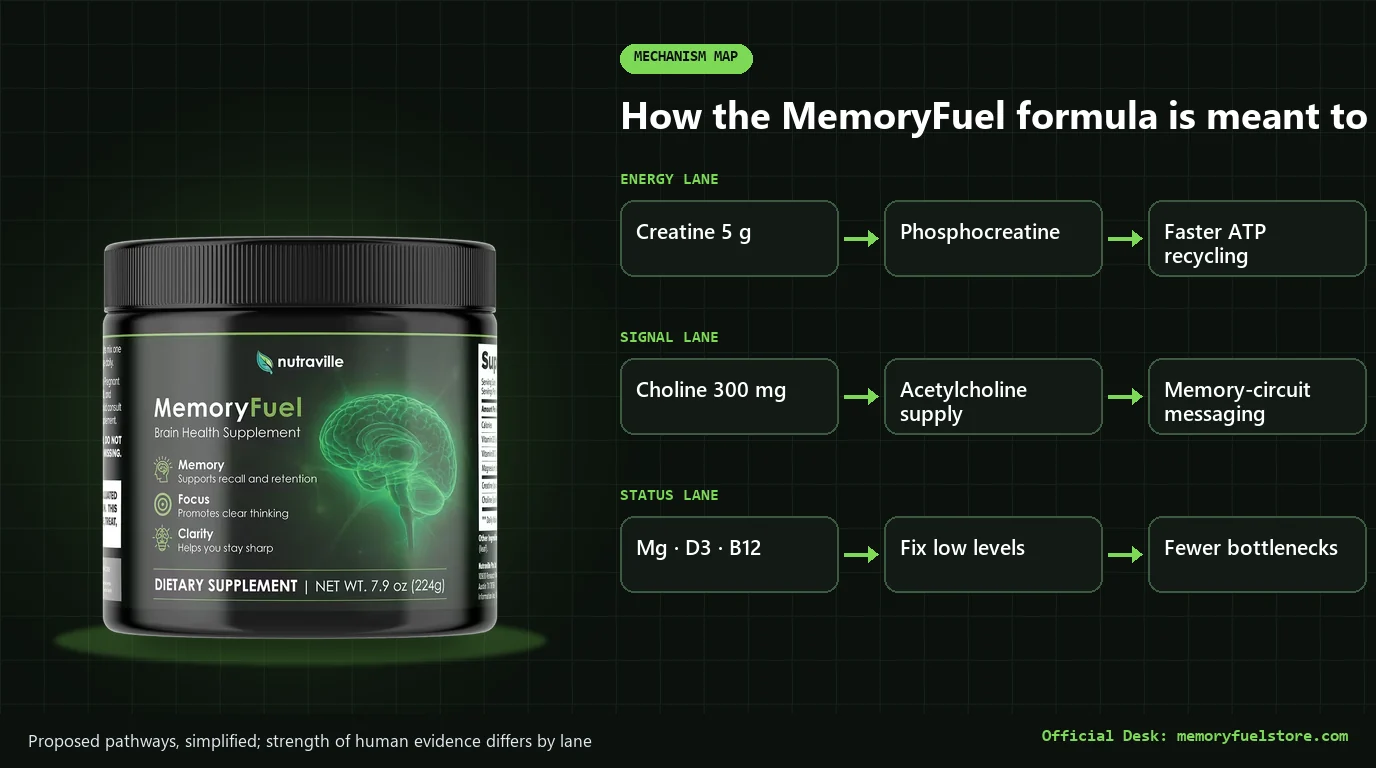
How MemoryFuel works, in one paragraph
MemoryFuel is built around one mechanism with good scientific grounding and four supporting nutrients. The mechanism is creatine's role as an energy buffer: brain cells store creatine as phosphocreatine and use it to regenerate ATP when demand jumps. Supplementing creatine raises brain stores a little, and in several trials that has translated into small improvements in memory and reasoning, especially in older adults and people under stress. Choline supplies the building block for acetylcholine, and magnesium, vitamin D3 and vitamin B12 correct shortfalls that can hold brain function back. None of this works like a drug, and none of it is fast.
Brain energy 101: why ATP matters for memory
Your brain is about 2 percent of your body weight but uses roughly a fifth of its resting energy. Almost all of that energy is spent as ATP, mostly to pump ions back across nerve cell membranes after each signal. Recalling a name under pressure, holding a phone number in mind, or switching between tasks all depend on neurons firing quickly and recovering quickly.
ATP itself is stored only in tiny amounts. The fastest backup system is the creatine kinase reaction: phosphocreatine hands its phosphate to ADP, instantly remaking ATP. Brain regions with heavy, bursty activity rely on this buffer. When researchers measure brain energy compounds with magnetic resonance spectroscopy, they can see phosphocreatine drop during demanding conditions and recover afterward[1].
The theory behind creatine supplements is straightforward: a fuller phosphocreatine buffer means less strain when demand peaks. It does not mean more energy in general, and it does not change how many neurons you have or repair damaged ones.
Getting creatine into the brain: slower than you think
Creatine is absorbed well from the gut[3], but the brain is guarded by the blood-brain barrier, and creatine crosses it through a specific transporter that does not work quickly. The brain also makes some of its own creatine. Together that means brain stores respond to supplements far less, and far more slowly, than muscle stores.
In the key imaging study, healthy volunteers took 20 g a day, four times MemoryFuel's dose, for four weeks. Total brain creatine rose by about 9 percent on average, with some regions rising more than others[2]. At 5 g a day the same rise probably takes longer. That is why we recommend judging MemoryFuel at six to eight weeks, not after a few days.
When creatine seems to help most
Reviews of the trials point to a pattern: benefits show up most when the brain is under strain or starts with lower creatine[4]. The groups with the clearest results include:
- Older adults. A 2023 meta-analysis found the memory benefit was considerably larger in people aged 66 to 76 than in younger adults[5].
- People short on sleep. A high single dose improved processing speed and short-term memory during sleep deprivation, alongside measurable changes in brain energy compounds[6].
- Vegetarians. With little dietary creatine, their stores start lower, and in an early trial 5 g a day for six weeks improved working memory and reasoning[7].
For well-rested young adults who eat meat, results have been small or absent. Knowing which group you fall into is the best predictor of whether MemoryFuel's main ingredient is likely to do anything noticeable for you.
The choline pathway: raw material for acetylcholine
Acetylcholine is the chemical messenger most associated with attention and memory formation. Nerve cells make it from choline and acetyl-CoA, and the main prescription drugs for Alzheimer's disease (donepezil, rivastigmine, galantamine) work by slowing its breakdown. It is tempting to think more choline means more acetylcholine and better memory, but the body tightly regulates acetylcholine production; providing more raw material does not force more output.
Where choline helps is in avoiding a shortfall. Most adults eat less than the adequate intake[8], and higher dietary choline has been associated with better memory test scores in a large cohort[9]. The 300 mg in MemoryFuel is best understood as nutritional insurance, not a cognitive enhancer. And to be clear, it is not a substitute for a prescribed cholinesterase inhibitor.
Magnesium: cofactor for energy and signaling
Inside cells, ATP is active mainly as a magnesium-ATP complex, so magnesium is involved in nearly every reaction that uses energy, including the creatine kinase system. Magnesium also sits inside NMDA receptors, acting as a gatekeeper that shapes how neurons respond during learning. In rats, raising brain magnesium enhanced learning and memory[11].
In people, the clearer story is deficiency. Low intake is widespread, and medicines such as proton pump inhibitors and some diuretics lower magnesium levels further[10]. Correcting low magnesium helps the systems that depend on it; adding more to normal levels has not been shown to boost memory.
Vitamin D3 and B12: removing common bottlenecks
Vitamin D receptors are spread throughout the brain, including the hippocampus, a center for memory. Low vitamin D has been linked with faster cognitive decline in observational studies, and supplement use was associated with fewer dementia diagnoses in a large U.S. cohort[13]. Trials have been less consistent[12], so the honest summary is: keep your level adequate, and do not expect a boost beyond that.
Vitamin B12 deficiency is one of the reversible causes of memory problems, which is why doctors test for it[14]. It becomes more common with age and with long-term metformin or acid-reducing drugs. In people with mild deficiency, B12 supplements corrected blood markers but did not improve cognitive tests over 24 weeks[15]. Its job in MemoryFuel is prevention.
What the sales page says vs. what the science shows
MemoryFuel's advertising is energetic. Here are its main claims set against the research, so you can calibrate expectations before you buy.
| Advertising claim | What the evidence shows |
|---|---|
| Results "within hours" | The fast result in research used about 25 g in one dose during sleep deprivation[6]. At 5 g a day, brain levels build over weeks. |
| Targets an "ATP gap" behind memory loss | Creatine buffers ATP; "ATP gap" is a marketing phrase, not a diagnosis, and memory loss has many causes[16]. |
| "Clinical dose" of creatine | Accurate: 5 g a day matches the dose used in memory trials[7]. |
| Vitamin D3 lowers dementia risk by 40% | From an observational cohort, not a trial; cause and effect are not established[13]. |
| Six synergistic ingredients | The label lists five actives; the combination itself has not been tested in a published trial. |
The limits of the mechanism
Memory depends on far more than brain energy. The 2024 Lancet Commission identified fourteen modifiable risk factors for dementia, including hearing loss, high LDL cholesterol, physical inactivity, smoking, depression, social isolation, high blood pressure and diabetes[16]. None of them is addressed by a supplement. Sleep, exercise, hearing aids if you need them, and good blood pressure control have stronger evidence than any powder.
Some memory changes are signs of illness rather than aging. If forgetfulness is getting worse, affects daily tasks or worries the people around you, the National Institute on Aging recommends seeing a doctor[17]. Treatable causes, including B12 deficiency, thyroid problems, medication side effects and depression, are common and worth ruling out before anything else.
How to tell whether it is working for you
Because changes are small and gradual, memory is a poor judge of its own improvement. A simple method works better than a feeling:
- Before your first scoop, write down three specific situations that bother you, for example "forgetting why I walked into a room," "losing names at church," "fading after lunch."
- Once a week, rate each from 1 to 5 in a single line of notes.
- Keep everything else steady: same sleep, same coffee, same medicines where possible.
- At week eight, compare the first and last lines. A consistent one-point shift is meaningful. Nothing at all is also meaningful, and it is what the 90-day refund window is for.
Questions about this topic
How does MemoryFuel work in the brain?
Mainly through creatine, which is stored as phosphocreatine and used to regenerate ATP quickly when brain cells are busy. Choline, magnesium, vitamin D3 and B12 support related systems and prevent common deficiencies.
Does MemoryFuel work right away?
Not at the normal dose. Brain creatine rises slowly, over weeks. Fast effects in research came from a single dose about five times larger than one scoop, taken during sleep deprivation.
Does MemoryFuel really work?
Its main ingredient has modest trial support for memory, mostly in older adults, vegetarians and people under stress. The finished product has not been tested in a published trial, so individual results vary and are not guaranteed.
Is MemoryFuel like a prescription memory drug?
No. Prescription Alzheimer's drugs change how acetylcholine is broken down or how certain receptors behave. MemoryFuel supplies nutrients and an energy buffer; it is not a drug and does not replace one.
Who is MemoryFuel most likely to help?
Based on the creatine research: adults over 65, people who eat little meat or fish, and people whose main complaint is mental fatigue or poor sleep. Well-rested younger meat-eaters may notice little.
Sources for this page
Every source below is linked to the original record. They evaluate ingredients or policies, not the MemoryFuel formula as a finished product.
- 1Forbes SC, Cordingley DM, Cornish SM, et al. Effects of creatine supplementation on brain function and health. Nutrients. 2022;14(5):921. pubmed.ncbi.nlm.nih.gov/35267907/
- 2Dechent P, Pouwels PJ, Wilken B, Hanefeld F, Frahm J. Increase of total creatine in human brain after oral supplementation of creatine-monohydrate. Am J Physiol. 1999;277(3):R698-R704. pubmed.ncbi.nlm.nih.gov/10484486/
- 3Persky AM, Brazeau GA. Clinical pharmacology of the dietary supplement creatine monohydrate. Pharmacol Rev. 2001;53(2):161-176. pubmed.ncbi.nlm.nih.gov/11356982/
- 4Avgerinos KI, Spyrou N, Bougioukas KI, Kapogiannis D. Effects of creatine supplementation on cognitive function of healthy individuals: a systematic review of randomized controlled trials. Exp Gerontol. 2018;108:166-173. pubmed.ncbi.nlm.nih.gov/29704637/
- 5Prokopidis K, Giannos P, Triantafyllidis KK, et al. Effects of creatine supplementation on memory in healthy individuals: a systematic review and meta-analysis of randomized controlled trials. Nutr Rev. 2023;81(4):416-427. pubmed.ncbi.nlm.nih.gov/35984306/
- 6Gordji-Nejad A, Matusch A, Kleedorfer S, et al. Single dose creatine improves cognitive performance and induces changes in cerebral high energy phosphates during sleep deprivation. Sci Rep. 2024;14:4937. pubmed.ncbi.nlm.nih.gov/38418482/
- 7Rae C, Digney AL, McEwan SR, Bates TC. Oral creatine monohydrate supplementation improves brain performance: a double-blind, placebo-controlled, cross-over trial. Proc Biol Sci. 2003;270(1529):2147-2150. pubmed.ncbi.nlm.nih.gov/14561278/
- 8NIH Office of Dietary Supplements. Choline: Fact Sheet for Health Professionals. ods.od.nih.gov/factsheets/Choline-HealthProfessional/
- 9Poly C, Massaro JM, Seshadri S, et al. The relation of dietary choline to cognitive performance and white-matter hyperintensity in the Framingham Offspring Cohort. Am J Clin Nutr. 2011;94(6):1584-1591. pubmed.ncbi.nlm.nih.gov/22071706/
- 10NIH Office of Dietary Supplements. Magnesium: Fact Sheet for Health Professionals. ods.od.nih.gov/factsheets/Magnesium-HealthProfessional/
- 11Slutsky I, Abumaria N, Wu LJ, et al. Enhancement of learning and memory by elevating brain magnesium. Neuron. 2010;65(2):165-177. pubmed.ncbi.nlm.nih.gov/20152124/
- 12NIH Office of Dietary Supplements. Vitamin D: Fact Sheet for Health Professionals. ods.od.nih.gov/factsheets/VitaminD-HealthProfessional/
- 13Ghahremani M, Smith EE, Chen HY, Creese B, Goodarzi Z, Ismail Z. Vitamin D supplementation and incident dementia: effects of sex, APOE, and baseline cognitive status. Alzheimers Dement (Amst). 2023;15(1):e12404. pubmed.ncbi.nlm.nih.gov/36874594/
- 14NIH Office of Dietary Supplements. Vitamin B12: Fact Sheet for Health Professionals. ods.od.nih.gov/factsheets/VitaminB12-HealthProfessional/
- 15Eussen SJ, de Groot LC, Joosten LW, et al. Effect of oral vitamin B-12 with or without folic acid on cognitive function in older people with mild vitamin B-12 deficiency: a randomized, placebo-controlled trial. Am J Clin Nutr. 2006;84(2):361-370. pubmed.ncbi.nlm.nih.gov/16895884/
- 16Livingston G, Huntley J, Liu KY, et al. Dementia prevention, intervention, and care: 2024 report of the Lancet standing Commission. Lancet. 2024;404(10452):572-628. pubmed.ncbi.nlm.nih.gov/39096926/
- 17National Institute on Aging. Memory Problems, Forgetfulness, and Aging. www.nia.nih.gov/health/memory-loss-and-forgetfulness/memory-problems-forgetfulness-and-aging
Ready to try MemoryFuel?
Orders complete on the maker's secure ClickBank checkout, with a 90-day refund policy that covers empty jars.